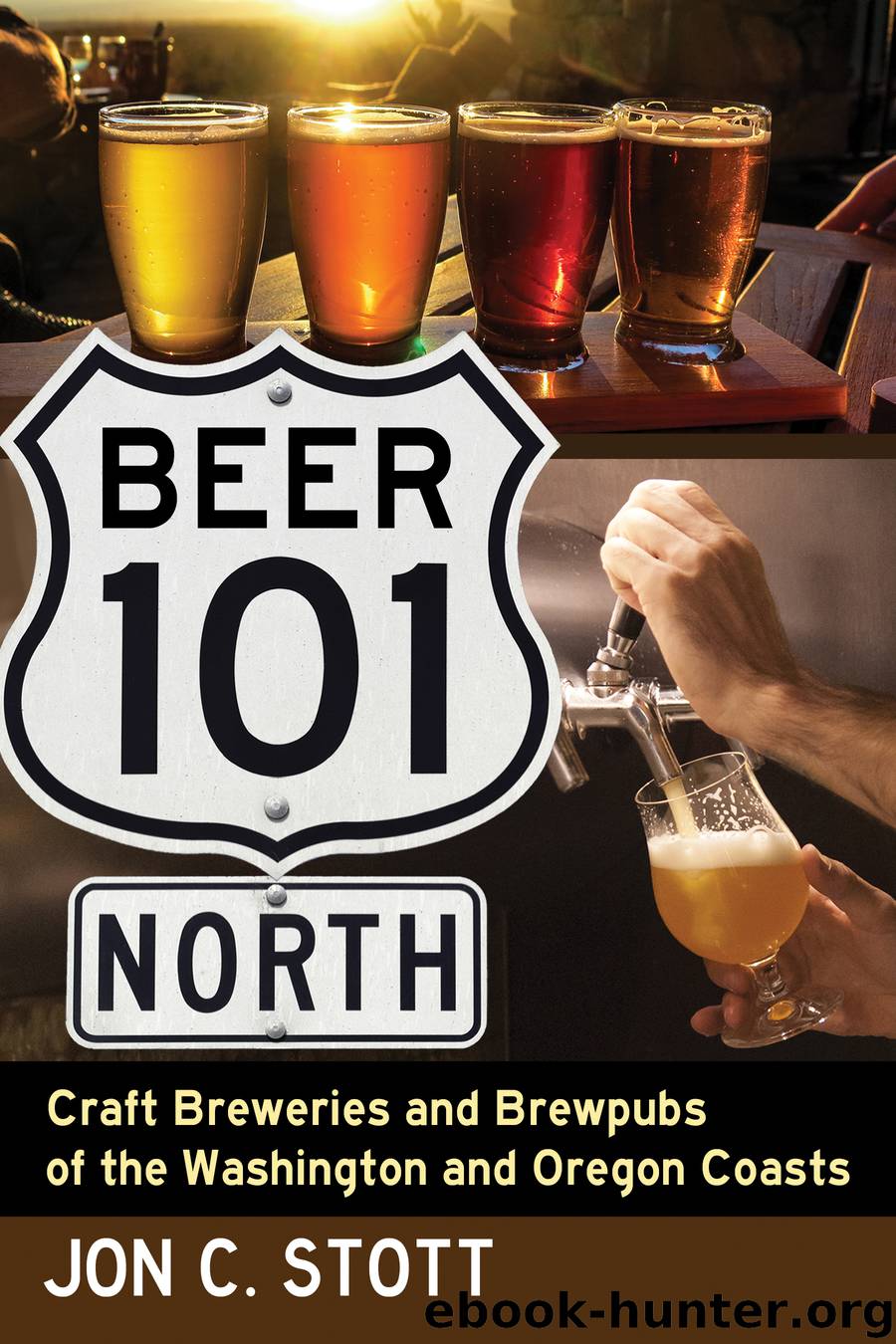
Beer 101 North by Jon C. Stott
Author:Jon C. Stott
Language: eng
Format: epub
Publisher: McFarland
Published: 2017-08-03T04:00:00+00:00
Trevor and Linsey Rogers of de Garde Brewing stand in front of one of the giant wooden foeders used to ferment and condition their wild-fermentation beers.
Trevor invited me on a tour of the brewery. We stopped first at the mash tun and kettle. “What we do here is pretty standard. We make and boil wort in the same way that other brewers do. Our grain bill is developed to create the style and alcoholic strength we’re looking for. We use hops—both the older and newer varieties—for flavor and aroma.” He did not mention bittering hops, which would counteract the subtle flavors they wanted in the finished product.
“It’s when we get over here that things get different,” he said as we walked toward the shallow rectangular vessel near the door. It was, I learned, a coolship, derived from the Dutch/Flemish word “koelschip,” and was used to cool the wort and to begin the process of wild fermentation. “There’s a lot of flat surface,” Trevor explained. “That speeds up the cooling and provides more area for the wild yeasts to settle on.” Its being near the door enhanced the cooling process and made it easier for yeasts and bacteria carried by the night breezes to get inside. “We put the wort in the coolship later in the afternoon and then, after 18 hours, we put it in barrels to begin the fermentation.” Essentially, after they’ve made the wort, the brewers don’t have much more to do with creating the finished product; the yeast does the work. Their main job is to move the liquid from kettle to coolship to barrels and finally to bottles and kegs.
The barrels into which the yeast infused wort is placed can be roughly categorized as either foeders (the enormous ones I’d seen) and simply barrels. de Garde has seven foeders, three with a 92-barrel capacity, two with 60, one with 50 and one with 25. There are, as well, 80 oak tanks, each with an 8.5 to 15-barrel capacity. After a fermentation period ranging from three or four months to three years, the end product is bottled. “We can’t make these beers anywhere but here,” he emphasized, using the word terroir, a term used to describe the influence of a specific place of growing on wines, to explain that, unlike regular brewing, which can use the basic ingredients anywhere, de Garde can’t get the airborne yeasts that give the beers their specific flavor anywhere but in the Tillamook area. “We are a deviation from the norm in current brewing,” he announced, a note of pride in his voice, “Many breweries use computers for every step of the brewing process and so, a brewery with multiple production facilities can make a specific style taste the same no matter where it comes from. They have complete control over every step of the process; we don’t.”
One batch of Bu Weisse (Berliner Weisse), one of the brewery’s most popular styles, may taste quite different from another. And sometimes, the results will be terrible—undrinkable beer.
Download
This site does not store any files on its server. We only index and link to content provided by other sites. Please contact the content providers to delete copyright contents if any and email us, we'll remove relevant links or contents immediately.
Craft Beer for the Homebrewer by Michael Agnew(18287)
Marijuana Grower's Handbook by Ed Rosenthal(3714)
Barkskins by Annie Proulx(3406)
Project Animal Farm: An Accidental Journey into the Secret World of Farming and the Truth About Our Food by Sonia Faruqi(3252)
Red Famine: Stalin's War on Ukraine by Anne Applebaum(2969)
The Plant Messiah by Carlos Magdalena(2962)
0041152001443424520 .pdf by Unknown(2888)
Organic Mushroom Farming and Mycoremediation by Tradd Cotter(2719)
In the Woods by Tana French(2638)
Between Two Fires by Christopher Buehlman(2529)
Beer is proof God loves us by Charles W. Bamforth(2492)
7-14 Days by Noah Waters(2452)
Borders by unknow(2361)
Reservoir 13 by Jon McGregor(2334)
The Art of Making Gelato by Morgan Morano(2282)
Meathooked by Marta Zaraska(2277)
Birds, Beasts and Relatives by Gerald Durrell(2246)
The 7 Habits of Highly Effective People: Powerful Lessons in Personal Change (25th Anniversary Edition) by Covey Stephen R(2224)
The Lean Farm Guide to Growing Vegetables: More In-Depth Lean Techniques for Efficient Organic Production by Ben Hartman(2152)
